A living archive of AI in the Mexican state.
Official documents, bills, precedents and public announcements about artificial-intelligence regulation in Mexico — organized without losing the paper trail.
Coverage
Verified documentary base
AI Use before the Federal Tribunal for Conciliation and Arbitration (Ley Federal de los Trabajadores al Servicio del Estado [Federal Law for State Workers], arts. 123 Bis through 123 Quinquies)
Adds a new Chapter I Bis to Title Seven of the Federal Law for State Workers (Ley Federal de los Trabajadores al Servicio del Estado) to regulate the use of AI tools in proceedings before the Federal Labor Arbitration Court.
Constitutional Reform: AI in the Administration of Justice (Article 17, CPEUM)
Adds a third paragraph to article 17 of the Constitution — the constitutional foundation of the package: recognizes the use of AI tools in the administration of justice under principles of human supervision and transparency.
AI Use in Administrative Procedure (LFPA, arts. 18-A to 18-D)
Adds a First Chapter A to Title Three of the Federal Law for Administrative Procedure (Ley Federal de Procedimiento Administrativo) to regulate the use of AI tools in federal administrative procedure.
Use of AI in the juicio contencioso administrativo federal (LFPCA, arts. 7 Ter a 7 Sexies)
Adds Chapter I Bis to Title I of the Ley Federal de Procedimiento Contencioso Administrativo (Federal Administrative Procedure Law) to permit AI tools and other support technologies in federal administrative litigation.
Use of AI in electoral remedies (General Law of the Electoral Remedies System (LGSMIME), art. 6 Bis)
Adds a Chapter I Bis to Title II of the General Law on the System of Electoral Remedy Procedures (Ley General del Sistema de Medios de Impugnación en Materia Electoral) to regulate the use of AI tools in remedy procedures..
Algorithmic Transparency in the Legislative Process (Reglamento del Senado — Senate Regulations)
Amends articles 169 and 190 and adds article 277 Bis to the Senate Regulations (Reglamento del Senado) to make transparent the use of AI in the legislative function: no significant AI intervention in the formation of a legislative product shall remain hidden.
Use of AI in Criminal Procedure (Código Nacional de Procedimientos Penales, articles 14 Bis through 14 Quinquies)
Adds a Chapter I Bis to Title II 'Principles and Rights in Proceedings' of the Código Nacional de Procedimientos Penales (National Criminal Procedure Code) to regulate the use of AI tools in criminal proceedings.
Use of AI in Labor Proceedings (Ley Federal del Trabajo [Federal Labor Law], arts. 688 Bis to 688 Quinquies)
Adds a Chapter I Bis to Title Fourteen 'Labor Procedural Law' of the Federal Law on Labor to regulate the use of AI tools in labor proceedings.
Use of AI in military criminal proceedings (Código Militar de Procedimientos Penales (Military Criminal Procedure Code))
Adds a Chapter I Bis to Title II of the Código Militar de Procedimientos Penales (Código Militar de Procedimientos Penales, arts.
Use of AI in Commercial Trials (Código de Comercio (Commercial Code), arts. 1055 Ter to 1055 Sexies)
Adds Chapter I Bis to Book Five 'On Commercial Trials' of the Código de Comercio (Commercial Code) to regulate the use of AI tools in commercial trials.
Use of AI in Civil and Family Procedures (CNPCyF)
Adds a First Bis Section to the Código Nacional de Procedimientos Civiles y Familiares (National Code of Civil and Family Proceedings) to regulate the use of AI tools in the civil and family justice system.
Use of AI in administrative responsibility proceedings (LGRA)
Adds a Third Title to the Second Book of the Ley General de Responsabilidades Administrativas (General Law of Administrative Responsibilities) regarding the use of AI tools in investigating and determining serious and non-serious faults and in the administrative responsibility proceeding.
Use of AI in Agrarian Justice (Ley Agraria (Mexican Agrarian Law), arts. 169 Bis to 169 Quinquies)
Adds a Chapter I Bis to Title Ten 'Of Agrarian Justice' of the Ley Agraria (Agrarian Law) to regulate the use of AI tools in agrarian disputes.
Use of AI in the amparo (Ley de Amparo, arts. 4 Bis–4 Quinquies)
Senator Agustín Dorantes proposes permitting artificial intelligence tools in amparo (Mexican constitutional relief) proceedings under ten principles, with responsibility always remaining with the judge.
Ley General para la Regulación y Uso Ético de la Inteligencia Artificial (General Law for the Regulation and Ethical Use of Artificial Intelligence)
Bill to enact a General Law on AI with general application (three levels of government, and companies/individuals that develop or market AI in the country).
CDMX Código Penal (Penal Code) Reforms on Identity Usurpation via Artificial Intelligence
Package of reforms unanimously approved to the Penal Code of Mexico City (Código Penal de la CDMX) that includes specific classification of identity usurpation through artificial intelligence, recognizing digital AI tools as a threat…
Initiative to Reform the Ley Federal del Trabajo (Federal Labor Law) to Regulate the Use of Artificial Intelligence in the Workplace
Initiative seeking to reform article 132 of the Ley Federal del Trabajo (Federal Labor Law) to establish clear limits on the use of AI systems at work.
Forthcoming Ley General para Regular y Fomentar el Uso de la Inteligencia Artificial (General Law to Regulate and Foster the Use of Artificial Intelligence)
Essential and foundational regulatory framework for the use of AI in Mexico, which will promote and regulate the use of this technology, accompanied by a national plan or strategy for its use.
Legislative Initiative to Reform the Ley Federal del Trabajo (Federal Labor Law) to Regulate the Use of Artificial Intelligence in the Workplace
Initiative to establish limits on the use of AI systems in the labor environment, especially regarding job displacement, digital surveillance, and automated labor decision-making, requiring companies to use AI as complementary to—not replacing—human employment.
Ley General para Regular y Fomentar el Uso de la Inteligencia Artificial en México - Versión Multipartidista del Senado (General Law to Regulate and Promote Artificial Intelligence in Mexico - Senate Multipartisan Version)
The country's first comprehensive AI law that classifies violations into three levels (minor, serious, and most serious), creates new national institutions, establishes the Autoridad Nacional de Inteligencia Artificial (National Artificial Intelligence Authority), prohibits nonconsensual sexual deepfakes, electoral manipulation with AI, and places special emphasis on protecting women, girls and vulnerable groups. Includes concepts of neuro-rights.
Bill to amend Article 30, Section IV of the Ley General de Educación (General Education Law) on artificial intelligence
Initiative to incorporate into education the responsible, ethical and gradual use of artificial intelligence, recognizing its impact on educational processes and the need for regulation in the pedagogical field.
Jucopo (Coordination Board) Agreement to Create Special Commission on Artificial Intelligence
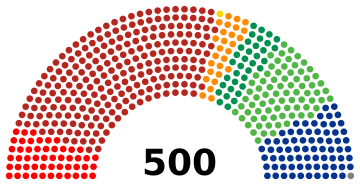
Creation of special commission composed of 9 deputies (3 MORENA, 2 PAN, 1 PVEM, 1 PT, 1 PRI, 1 MC) plus the president of the Commission on Science, Technology and Innovation (Comisión de Ciencia, Tecnología e Innovación), with the purpose of analyzing, monitoring and evaluating the…
Initiative with draft decree reforming Section IV of Article 30 of the Ley General de Educación (General Education Law) concerning artificial intelligence in education
Proposes amending the Ley General de Educación (General Education Law) to include specific provisions on the use of artificial intelligence in educational processes, establishing criteria for responsible and ethical pedagogical implementation in the…
Amendment to the General Education Law of the State of Mexico (Ley General de Educación del Estado de México) to Promote Responsible Use of Artificial Intelligence in Education
Reform approved by the State of Mexico Congress (Congreso mexiquense) for educational authorities to promote responsible, ethical, and gradual use of artificial intelligence among teaching staff and upper and higher education students…
Reform to the Ley de Educación del Estado de México (Educational Law of the State of Mexico) to Promote Responsible Use of Artificial Intelligence in Education
Approved reform establishing that educational authorities must promote among teaching staff and upper secondary and higher education students the responsible, ethical, and gradual use of artificial intelligence for educational purposes,…
Reform to Article 61 of the Ley de Educación del Estado de México (Education Law of the State of Mexico) to promote the responsible, ethical, and gradual use of artificial intelligence for educational purposes at upper-secondary and university levels
Initiative unanimously approved to amend the Law on Education for the State of Mexico (Ley de Educación del Estado de México), establishing that educational authorities promote among teaching staff and students in upper secondary and higher education the responsible,…
Educational Reform Initiative to Promote Responsible AI Use in Upper-Secondary and Higher Education
Initiative approved by the State of Mexico Congress (Congreso mexiquense) that requires educational authorities to promote responsible, ethical, and gradual use of artificial intelligence among teachers and students in upper-secondary and higher education…
Ley General para Regular y Fomentar el Uso de la Inteligencia Artificial en México (General Law to Regulate and Promote the Use of Artificial Intelligence in Mexico)
Mexico's first comprehensive artificial intelligence law that classifies violations into three levels (minor, serious and most serious), establishes penalties ranging from fines to imprisonment for deepfakes and electoral manipulation, creates a Autoridad Nacional de IA (National AI Authority),…
Punto de Acuerdo (Agreement Point) urging the Junta de Coordinación Política (Political Coordination Board) to create a Comisión Especial (Special Commission) aimed at designing and articulating a comprehensive regulatory framework for the enactment of the Ley Nacional de Inteligencia Artificial (National Artificial Intelligence Law)
Proposal to create a Special Commission in the Cámara de Diputados (Chamber of Deputies) responsible for designing and articulating a comprehensive regulatory framework for issuing a National Law on Artificial Intelligence, with the goal of building a…
Senate's First Artificial Intelligence Act - Comprehensive Multiparty Framework
Historic legislative initiative proposing the first comprehensive legal framework for AI in Mexico after 10 months of multi-party joint work.
Proposal to Add to the Documento Renuncias Recaudatorias (DRR) 2027 Taxpayers Investing in AI Development and Implementation
Punto de acuerdo (parliamentary motion) requesting fiscal authorities to incorporate tax incentives for taxpayers investing in AI development and implementation, with the goal of promoting Mexican technologies and accelerating their…
By punto de acuerdo (motion), requesting that tax authorities respectfully incorporate into the Documento Renuncias Recaudatorias (DRR) 2027 taxpayers who invest in the development and implementation of Artificial Intelligence
Motion for agreement to request tax incentives for taxpayers investing in the development and implementation of artificial intelligence, promoting technological innovation with tax benefits
Initiative proposing a draft decree to amend and supplement the Ley General de los Derechos de Niñas, Niños y Adolescentes (General Law on the Rights of Children and Adolescents) concerning protection from cyber violence and artificial intelligence
Proposes to reform and amend provisions of the General Law on the Rights of Girls, Boys and Adolescents (Ley General de los Derechos de Niñas, Niños y Adolescentes) to protect minors from cybernetic digital violence and artificial intelligence, establishing specific protection measures…
Package of 10 Initiatives on Artificial Intelligence and Protection of Women and Girls
Comprehensive package that includes: 1) Amendment to article 73 of the Constitution to grant Congress authority over AI and cybersecurity; 2) Amendment to the General Education Law to incorporate AI studies; 3) Safe internet with AI for minors;…
Package of 10 Initiatives by Michel González on Artificial Intelligence and Protection of Women and Girls (including Constitutional Amendment to Article 73)
Package of 10 initiatives focused on two areas: Artificial Intelligence regulation and strengthening rights and protection of women, girls, children, and adolescents.
That reforms various provisions of the Código Penal Federal (Federal Penal Code), regarding sexual violence generated with artificial intelligence
Initiative to reform provisions of the Federal Criminal Code (Código Penal Federal) to penalize sexual violence generated through the use of artificial intelligence, addressing the risks of AI in the generation of non-consensual sexual content
Amendment to Article 199 Octies of the Código Penal Federal (Federal Penal Code) on the Creation of Intimate Content via Artificial Intelligence
Initiative adding a third paragraph to article 199 Octies of the Federal Penal Code (Código Penal Federal) to criminalize the use of artificial intelligence techniques, applications, or programs to create, manipulate, and distribute videos, audios, images, and prints of intimate content of a person without their consent. It specifically focuses on combating sexual deepfakes and digital violence against women.
Initiative for the Regulation of Artificial Intelligence of the State of Michoacán
State initiative aimed at establishing a legal framework to regulate the use of AI in various everyday areas, from digital services to administrative processes.
Amendment to and expansion of various provisions of the Ley Federal del Derecho de Autor (Federal Copyright Law) and the Ley Federal de Protección de Datos Personales en Posesión de los Particulares (Federal Law for Personal Data Protection in Private Hands) regarding AI-altered images and deepfakes
Comprehensive initiative proposing to reform and add provisions to both the Federal Law of Copyright (Ley Federal del Derecho de Autor) and the Federal Law for Protection of Personal Data in Private Hands (Ley Federal de Protección de Datos Personales en Posesión de los Particulares) to specifically regulate…
Amendment to Article 73 of the Political Constitution of the United Mexican States (Mexican Constitution) regarding artificial intelligence
Bill that proposes to reform article 73 of the Constitución Política de los Estados Unidos Mexicanos (Political Constitution of the United Mexican States) to empower the Congreso de la Unión (Congress of the Union) to legislate in the matter of artificial intelligence, establishing the constitutional foundations…
That amend and add various provisions to the Ley Federal del Derecho de Autor (Federal Copyright Law), and add provisions to the Ley Federal de Protección de Datos Personales en Posesión de los Particulares (Federal Law for Personal Data Protection Held by Private Parties), regarding images altered with Artificial Intelligence or deepfakes
Initiative seeking to regulate the use of artificial intelligence in the creation of synthetic content (deepfakes) by establishing protections regarding copyright and personal data protection.
That reforms and adds various provisions of the Ley Federal del Derecho de Autor (Federal Copyright Law), in the matter of artificial intelligence
Iniciativa que busca actualizar la Ley Federal del Derecho de Autor para abordar los desafíos que plantea la inteligencia artificial en materia de propiedad intelectual, incluyendo la protección de obras creadas con asistencia de IA y…
That amends articles 199 Septies, 199 Octies and 202 of the Código Penal Federal (Federal Criminal Code) regarding misuse of artificial intelligence
Initiative amending various articles of the Federal Criminal Code (Código Penal Federal) to incorporate misuse of artificial intelligence as an aggravating factor in crimes involving violations of sexual privacy and other offenses, including criminalization of those who produce material using instruments such as artificial intelligence
Amendments to Title Nine; Adds Chapter III and Article 211 Bis 8 to the Código Penal Federal (Federal Criminal Code) on artificial intelligence misuse and related technologies
Legislative initiative proposing the creation of a new specific chapter in the Mexican Federal Criminal Code (Código Penal Federal) dedicated to improper use of artificial intelligence and similar technologies, establishing specific criminal provisions to regulate the misuse of…
Reform to Articles 199 Octies and 211 Bis 1 of the Código Penal Federal (Federal Penal Code), regarding altered images using artificial intelligence or deepfakes
Initiative proposing reform to Articles 199 Octies and 211 Bis 1 of the Federal Criminal Code (Código Penal Federal) to include specific provisions on the misuse of artificial intelligence-altered images and deepfakes, establishing…
That amends the first paragraph of articles 199 Septies and 199 Octies, and the final paragraph of article 202 of the Código Penal Federal (Federal Penal Code), concerning the improper use of Artificial Intelligence
Iniciativa (draft bill) that amends various provisions of the Código Penal Federal (Federal Penal Code) to address the misuse of artificial intelligence in sensitive areas such as education and professional life.
Initiative of the Ley General de Inteligencia Artificial (General Artificial Intelligence Law) (Senado)
Initiative under development by the Comisión del Senado de análisis, seguimiento y evaluación (Senate Commission for Analysis, Monitoring and Evaluation) of Artificial Intelligence Application and Development in Mexico.
That adds Article 77 Bis to the Ley General de los Derechos de Niñas, Niños y Adolescentes (General Law for the Rights of Children and Adolescents), regarding synthetic content generated through artificial intelligence
Initiative proposing to add Article 77 Bis to the General Law for the Protection of Children and Adolescents (Ley General de los Derechos de Niñas, Niños y Adolescentes) to regulate and protect minors against synthetic content generated through artificial intelligence that…
Reform of Article 199 Octies of the Código Penal Federal (Federal Criminal Code) regarding parental control, prevention, and sanctions for sexual privacy crimes committed through artificial intelligence programs or platforms
Amendment to the Federal Criminal Code (Código Penal Federal) to punish crimes violating sexual privacy committed through artificial intelligence programs or platforms, with emphasis on parental control and prevention of gender-based violence…
Initiative with draft decree through which fourth and fifth paragraphs are added to article 202 of the Código Penal Federal (Federal Criminal Code)
Amendment to the Código Penal Federal (Federal Criminal Code) to penalize conduct related to misuse of artificial intelligence in the creation and distribution of non-consensual sexual content and artificially generated child sexual abuse material, in response to…
Punto de acuerdo (legislative agreement point) requesting the Secretariado Ejecutivo del SNSP (Executive Secretariat of the National Public Safety System) and INEGI (National Institute of Statistics and Geography) to incorporate and systematize information related to the use of artificial intelligence in the commission of crimes
Punto de acuerdo (Agreement point) requesting the Secretariado Ejecutivo del SNSP (Executive Board of the National Public Security System) and INEGI to incorporate and systematize information related to the use of artificial intelligence in the commission of...
Punto de Acuerdo (Agreement Point) to urge local legislatures to criminalize sexual offenses involving artificial intelligence
Agreement Point (Punto de Acuerdo) that urges the legislatures of the federal entities to criminalize sexual conduct committed through the use of artificial intelligence, including the generation of false intimate content.
Punto de Acuerdo (Motion) on Systematization of Information on AI in Crimes
Procedural Agreement requesting the Secretariado Ejecutivo del Sistema Nacional de Seguridad Publica (Executive Secretariat of the National Public Security System, SNSP) and INEGI to assess the incorporation and systematization of information related to artificial intelligence use in...
Initiative to Reform the Código Penal Federal (Federal Criminal Code) on Digital Violence with AI
Initiative that reforms and adds various provisions to the Federal Penal Code (Código Penal Federal) to penalize the use of artificial intelligence in the creation and dissemination of false intimate sexual content (deepfakes), establishing specific penalties for these crimes.
Initiative on aggravating factors for AI use in the commission of crimes
Initiative that adds various provisions to the Codigo Penal Federal (Federal Penal Code) to establish aggravating factors in crime commission when artificial intelligence is used as a tool for its perpetration.
Constitutional reform initiative on digital ecosystems and artificial intelligence
Initiative that reforms various articles of the Political Constitution of the United Mexican States (Constitucion Politica de los Estados Unidos Mexicanos) regarding recognition of digital ecosystems and artificial intelligence, seeking to establish a constitutional framework for…
Initiative to Reform Article 6 of the Constitution on Artificial Intelligence
Initiative that reforms the third paragraph of Article 6
Reform to Article 6, third paragraph, of the Constitución Política de los Estados Unidos Mexicanos (Mexico's Political Constitution), concerning artificial intelligence
Constitutional reform initiative that proposes to modify the third paragraph of Article 6 of the Constitución Política de los Estados Unidos Mexicanos to incorporate provisions related to artificial intelligence.
Federal Initiative to Regulate Artificial Intelligence
Regulatory framework to responsibly develop, implement, and oversee AI in Mexico.
Initiative to Protect Voice Dubbing Actors Against Unauthorized Use of Their Voices by Artificial Intelligence
Government bill seeking to protect dubbing actors against unauthorized use of their voices by Artificial Intelligence, described as the first initiative that would provide protection to workers who lack formal employment contracts…
Legislative Initiative on Artificial Intelligence and Personal Data Processing by Public Entities in Mexico City (INFO CDMX)
Bill initiative presented by the Instituto de Transparencia, Acceso a la Información Pública, Protección de Datos Personales y Rendición de Cuentas de la Ciudad de México (Institute for Transparency, Access to Public Information, Personal Data Protection, and Accountability of Mexico City) to regulate artificial intelligence use and personal data processing by…
Ley Nacional para Regular el Uso de la Inteligencia Artificial (National Law to Regulate the Use of Artificial Intelligence) (Senate)
Comprehensive national law to regulate and control AI use in public and private spheres, establishing the Regulatory Agency for the Development, Use and Application of Artificial Intelligence with broad regulatory powers, risk-level classification…
Initiative with draft decree to enact the Ley Nacional para Regular el Uso de la Inteligencia Artificial (National Law to Regulate the Use of Artificial Intelligence)
Proposes to establish for the first time in Mexico a comprehensive legal framework applicable to the development, implementation, and use of artificial intelligence (AI) systems, both in the public and private sectors.
Ley Nacional para Regular el Uso de la Inteligencia Artificial (National Law for Regulating the Use of Artificial Intelligence)
Bill proposing to enact the National Law to Regulate the Use of Artificial Intelligence, establishing for the first time in Mexico a comprehensive legal framework applicable to the development, implementation, and use of AI systems in both…
Initiative for a National Law to Regulate the Use of Artificial Intelligence
Law of public order and general application seeking to regulate and control AI use in public and private spheres, guaranteeing protection of human rights.
AI Regulation to Combat Digital Violence and Deepfakes - Reform to the Código Penal Federal (Federal Penal Code) and Ley de Acceso de las Mujeres a una Vida Libre de Violencia (Law on Women's Access to a Violence-Free Life)
Initiative to reform the Federal Criminal Code (Código Penal Federal) and the General Law for Women's Access to a Violence-Free Life (Ley General de Acceso de las Mujeres a una Vida Libre de Violencia), aimed at penalizing forms of gender-based violence generated through the misuse of artificial intelligence technologies…
Archivo no encontrado
Initiative to empower the Congreso de la Unión (Congress of the Union) to legislate on artificial intelligence, modifying article 73 of the Constitución (Constitution) to expressly include AI regulation alongside general communications and telecommunications pathways…
Amends Articles 5 and 20 Bis of the Ley General de Acceso de las Mujeres a una Vida Libre de Violencias (General Law for Women's Access to a Life Free of Violence), regarding political gender violence caused by artificial intelligence
Initiative (iniciativa) proposing to add Section XXI to Article 5 and reform the final paragraph of Article 20 Bis of the General Law for Women's Access to a Life Free of Violence (Ley General de Acceso de las Mujeres a Una Vida Libre de Violencia), to specifically include gender-based political violence caused by artificial intelligence…
Initiative with a bill to add Section XXI to Article 5 and amend the final paragraph of Article 20 Bis of the Ley General de Acceso de las Mujeres a Una Vida Libre de Violencia (General Law on Women's Right to a Life Free of Violence), regarding gender-based political violence caused by artificial intelligence
Amends the Ley General de Acceso de las Mujeres a una Vida Libre de Violencia (General Law on Women's Access to a Life Free of Violence) to specifically include gender-based political violence perpetrated through the use of artificial intelligence, such as the creation of deepfakes,…
Initiative to Add a Fourth Paragraph to Article 202 Ter of the Código Penal Federal (Federal Criminal Code) on Pornography Based on Sexual Orientation, Gender Identity, or Social Status
Proposes adding aggravating factors to the pornography offense when artificial intelligence is used to create synthetic sexual content targeting LGBTTTIQ+ persons or vulnerable groups, recognizing new forms of digital violence and discrimination enabled by generative AI.
Amending articles 202 and 202 Bis of the Código Penal Federal (Federal Criminal Code) regarding child pornography
Adds provisions to the Código Penal Federal (Federal Criminal Code) to punish child pornography generated through artificial intelligence, responding to the emergence of generative AI and its risks to minors
That amends articles 202 and 202 Bis of the Código Penal Federal (Federal Criminal Code) on child sexual abuse material
Amendment to the Código Penal Federal (Federal Criminal Code) to specifically criminalize the creation, production, distribution and commercialization of child sexual abuse material generated through artificial intelligence, recognizing the new risks posed by generative technologies...
Amending the Código Penal Federal (Federal Penal Code) to add Article 202 Ter regarding pornography based on sexual orientation, gender identity, or social status
Initiative to add a fourth paragraph to Article 202 Ter of the Federal Criminal Code (Código Penal Federal) to penalize the creation, distribution, or dissemination of artificial intelligence-generated sexually explicit images depicting persons…
That amends articles 202 and 202 Bis of the Código Penal Federal (Mexican Federal Penal Code), regarding child sexual abuse material
Initiative reforming the Código Penal Federal (Federal Penal Code) to include specific provisions on child sexual abuse material generated with artificial intelligence.
Ley General para el Uso y Control de la Inteligencia Artificial en los Sectores Público y Privado (General Law for the Use and Control of Artificial Intelligence in Public and Private Sectors)
Initiative with bill to enact the Ley General para el Uso y Control de la Inteligencia Artificial en los Sectores Público y Privado (General Law for the Use and Control of Artificial Intelligence in Public and Private Sectors).
Constitutional amendment to Article 73 to empower Congress in AI matters (Senate - Karina Ruiz)
Initiative with a bill that amends Article 73 of the Political Constitution of the United Mexican States (Constitución Política de los Estados Unidos Mexicanos) to authorize the Congress of the Union (Congreso de la Unión) to enact legislation on artificial intelligence.
Exhorto (legislative exhortation) from the Congreso de Coahuila (Coahuila State Congress) to the Congreso de la Unión (National Congress) to promote a comprehensive regulatory framework for artificial intelligence
Agreement approved by the Standing Delegating Committee (Diputación Permanente) of the Coahuila State Congress that urges the National Congress to promote and continue as a priority the legislative procedures necessary for the construction of a comprehensive regulatory framework for artificial intelligence in Mexico.
Legislative initiative with a bill to amend Article 199 Septies of the Código Penal Federal (Federal Criminal Code), concerning the manipulation of images with artificial intelligence for sexual purposes
Initiative seeking to punish with 4 to 8 years imprisonment and fines of 400 to 1,000 days to anyone who digitally manipulates images through AI to make them appear nude or involved in explicit sexual activities.
That adds a section XXXIII to Article 73 of the Constitución Política de los Estados Unidos Mexicanos (Political Constitution of the United Mexican States), on artificial intelligence matters
Initiative that proposes granting the Congreso de la Unión (Congress) the power to issue laws on artificial intelligence, regulating the training systems used by private parties that develop machine learning models…
That adds various provisions to the Código Penal Federal (Federal Criminal Code) regarding offenses committed using artificial intelligence systems
Initiative proposing the addition of Title Nine Bis to the Federal Criminal Code (Código Penal Federal) to classify and penalize crimes committed through artificial intelligence systems.
Initiative to reform section XVII of article 73 of the Constitución Política de los Estados Unidos Mexicanos (Political Constitution of the United Mexican States) to authorize Congress of the Union to regulate artificial intelligence and technological devices
Constitutional amendment seeking to authorize Congreso de la Unión (Congress of the Union) to enact laws regulating, establishing requirements and limits, operation, principles and foundations for the use of artificial intelligence (AI) and all types of related technological devices, as well as to enact the necessary legislation to make these powers effective
Reform to the Código Penal de Oaxaca (Oaxaca Penal Code) - Chapter X 'Artificial Intelligence' (4-8 years)
Historic reform to Oaxaca's Penal Code (Código Penal de Oaxaca) approved by the LXVI Legislature on December 2, 2025.
State AI Law Bill Initiative in Chihuahua (in committees)
Legislative process underway to create Mexico's First Comprehensive State AI Law (not a criminal reform).
Reform to the Penal Code of the State of Mexico (Código Penal del Estado de México) - Intimate Deepfakes (up to 5 years imprisonment)
Reform to the Penal Code of the State of Mexico to punish the creation and distribution of intimate deepfakes.
Penal Code of Michoacán (Código Penal de Michoacán) Reform - Digital Violence, Cyberstalking, and AI-Generated Sexual Content
Initiatives presented by Deputy Brissa Arroyo (2024-2025) to reform the Código Penal de Michoacán (Michoacán Penal Code).
Bill with draft decree amending article 199 Octies of the Código Penal Federal (Federal Criminal Code) concerning parental control, prevention and prosecution of sexual privacy violations committed using artificial intelligence programs or platforms
Proposes reforming the Federal Penal Code (Código Penal Federal) to establish parental control, prevent and punish crimes of violation of sexual privacy committed through the use of artificial intelligence programs or platforms, as well as…
Código Penal de Querétaro (Querétaro Penal Code) Reform - Non-Consensual Intimate Images with AI (3-6 years imprisonment)
Reform to the Querétaro Penal Code (Código Penal de Querétaro) to penalize manipulation of AI-generated images.
Amendment to Articles 211 Bis 8 and Others of the Federal Penal Code (Código Penal Federal) - AI-generated stickers and memes
Initiative to add Articles 211 Bis 8 and 211 Bis 9 to the Federal Penal Code (Código Penal Federal) to impose sentences of 3 to 6 years in prison and fines ranging from 300 to 600 days on anyone who creates, manipulates, or distributes images, videos, audio, or digital content generated with AI without consent for the purpose of ridiculing, harassing, or damaging a person's reputation…
LFPPI Reform - Technology Transfer, Patent Simplification, and Artificial Intelligence Regulation
Initiative from the Federal Executive submitted by President Claudia Sheinbaum on September 15, 2025 to the Senate.
Initiative with draft decree to add a paragraph to Section VI of Subsection B of Article 6 of the Constitución Política de los Estados Unidos Mexicanos (Mexican Constitution), regarding digital identity protection
Proposes a constitutional reform to explicitly recognize the right to protection of digital identity, defined as the set of personal attributes susceptible to manipulation by artificial intelligence.
Reform for Labeling and Protection Against AI-Generated Content
Initiative to add Article 32 Bis to the Ley Federal de Protección al Consumidor (Federal Consumer Protection Law) and Article 221 Bis to the Ley en Materia de Telecomunicaciones y Radiodifusión (Telecommunications and Broadcasting Law), establishing the obligation to label AI-generated…
Constitutional reform to article 73 to grant Congress authority in artificial intelligence matters
New constitutional reform proposal to grant Congress powers over artificial intelligence
Decree amending and supplementing various provisions of the Código Penal Federal (Federal Criminal Code) and the Ley Federal del Derecho de Autor (Federal Copyright Law), regarding generative artificial intelligence
Reform that sanctions misuse of technological tools based on generative artificial intelligence, establishes sentences of 6 months to 4 years in prison, protects works created with AI assistance, and adjusts the definition of…
Ley Federal para el Desarrollo Ético, Soberano e Inclusivo de la Inteligencia Artificial (Federal Law for the Ethical, Sovereign, and Inclusive Development of Artificial Intelligence)
Initiative to enact the Federal Law for the Ethical, Sovereign and Inclusive Development of Artificial Intelligence.
Dictamen (Opinion) on Digital Violence with Generative AI - Comisión de Igualdad de Género (Gender Equality Commission)
Dictamen (legislative committee opinion) from the Comisión de Igualdad de Género (Gender Equality Commission) on the initiative to impose sanctions for digital violence through the use of generative artificial intelligence.
Decree Amending and Adding Various Provisions of the Ley Federal de Cinematografía (Federal Film Law), the Ley Federal del Derecho de Autor (Federal Copyright Law), and the Ley Federal del Trabajo (Federal Labor Law), on Measures for Protecting Dubbing Actors Against the Use of Artificial Intelligence
Initiative seeking to protect dubbing actors against artificial intelligence and voice cloning technologies in dubbing processes.
Initiative with a bill to enact the Ley Federal para el Desarrollo Ético, Soberano e Inclusivo de la Inteligencia Artificial en México (Federal Law for the Ethical, Sovereign and Inclusive Development of Artificial Intelligence in Mexico)
Bill proposing an innovative, ethical, and deeply human law establishing a risk traffic-light system that classifies AI technologies into minimal, limited, high, and prohibited risk levels based on their potential impact...
Yucatán CP Initiative - Comprehensive Reform on Cybercrime and AI
Comprehensive technical bill introduced on September 1, 2023 by deputies Gaspar Armando Quintal Parra and Karla Reyna Franco Blanco (PRI).
Guanajuato Penal Code Initiative - Chain Liability for AI (+50% penalty increase)
Comprehensive initiative to reform the Penal Code (Código Penal) of Guanajuato presented in February 2025 (Bulletin 9010 of 02/27/2025).
Which amends Section XVII of Article 73 of the Constitución Política de los Estados Unidos Mexicanos (Political Constitution of the United Mexican States) on matters of artificial intelligence
Legislative initiative proposing reform to Section XVII of Article 73 of the constitution to expressly include artificial intelligence within the subject matters that the Congreso de la Unión (Mexican Congress) is empowered to legislate on, with the objective of…
Constitutional amendment to Article 73 on artificial intelligence (Ricardo Monreal)
Amends section XVII of article 73 of the Constitution to expressly empower Congress to legislate on artificial intelligence
Campeche CP Initiative - Digital Violence and Deepfakes with AI (Ley Olimpia (Olympia Law) + AI)
Initiative INI078LXV0225 presented on February 11, 2025 by the Morena Parliamentary Group (16 deputies) in the LXV Legislature of the Campeche State Congress.
National Bill Initiative Regulating the Use of Artificial Intelligence
Bill under development by the Commission for Analysis, Monitoring and Evaluation of AI Application and Development in Mexico.
Reforma a Ley en Materia de Telecomunicaciones y Radiodifusión (Reform to the Telecommunications and Broadcasting Law) - Identification of AI-Generated Content
Regulatory framework to identify and make transparent the origin of AI-generated digital content.
National Law Regulating the Use of AI (Ley Nacional que regula el uso de la IA)
Risk-based approach (similar to EU).
Ley para el Uso de Inteligencia Artificial y el Tratamiento de Datos Personales por Sujetos Obligados de la Ciudad de México (Law for the Use of Artificial Intelligence and Processing of Personal Data by Obligated Subjects of Mexico City)
Law on the Use of Artificial Intelligence and the Processing of Personal Data by Obligated Subjects of Mexico City.
Ley para el uso de inteligencia artificial y el tratamiento de datos personales por sujetos obligados en la Ciudad de México (Law for the Use of Artificial Intelligence and the Treatment of Personal Data by Obligated Entities in Mexico City)
One of the first legislative initiatives in Latin America specifically focused on regulating the use of AI by the public sector in personal data processing.
Proposed Bill for the Use of Artificial Intelligence and Personal Data Processing by Obligated Subjects in the CDMX
Initiative presented by INFO CDMX to specifically regulate artificial intelligence use by obligated subjects in Mexico City, establishing rules for proper personal data handling when…
Bill on Artificial Intelligence and Personal Data Processing for Obligated Subjects in Mexico City
Initiative aimed at regulating the implementation of artificial intelligence for the adequate use and management of personal data of Mexico City residents.
Iniciativa de Ley (Bill) on Artificial Intelligence and Personal Data Treatment for Obligated Subjects in Mexico City
Initiative by the Institute for Transparency of Mexico City that seeks to regulate the implementation of Artificial Intelligence for the appropriate use and benefit regarding the handling of personal data of Mexico City residents.
Reform to Ley General de Salud (Mexican General Health Law) - AI Applied to Health
Addition of provisions on artificial intelligence applied to healthcare
Initiative to Create the Ley General de Ciberseguridad (General Cybersecurity Law)
Initiative to create a General Cybersecurity Law (Ley General de Ciberseguridad) regulating data protection and computer systems, and establishing the National Cybersecurity Agency (Agencia Nacional de Ciberseguridad) to coordinate efforts against digital threats
Quintana Roo Penal Code (Código Penal) Amendment - Article 20 Bis: General AI Aggravating Factor (+50% Sentence Enhancement)
Amendment to the Código Penal de Quintana Roo (Quintana Roo Penal Code) that adds Article 20 Bis as a general aggravating factor: increases sentences up to 1.5 times (by half) for ANY crime committed with the use of artificial intelligence.
Ley Federal que regula la Inteligencia Artificial (Federal Law Regulating Artificial Intelligence)
Risk-level approach (unacceptable, high, low) similar to EU.
Amendment to Article 73 of the Constitution - AI (PRD variant)
Adds Section XXIX-Z Bis to authorize Congress to enact laws on artificial intelligence, establishing the basis for federal, state and municipal participation
Reform of Article 1916 of the Código Civil Federal (Federal Civil Code) and Addition of Article 368 Sexties to the Código Penal Federal (Federal Criminal Code)
Civil and criminal liability for damages caused by AI
Reform to the Ley Federal del Derecho de Autor (Federal Copyright Law)
Copyright in AI-generated works
Amendment to Articles 21 and 24 of the Ley Federal del Derecho de Autor (Federal Copyright Law)
Regulation of copyright rights in AI-generated content
Comprehensive Reform to Ley Federal del Derecho de Autor (Federal Copyright Law) - AI
Reforms articles 5, 11, 17, 24; adds paragraphs to articles 4, 13; adds subsection XI to article 14; and adds article 114 Bis.
Reform to Articles 20 Ter and 20 Quáter of the Ley General de Acceso de las Mujeres a una Vida Libre de Violencia (General Law on Women's Access to a Life Free of Violence)
Initiative presented by Deputy Julieta Kristal Vences Valencia (Morena) to the LXV Legislature on February 18, 2025.
Reform to the Ley General en materia de Humanidades, Ciencias, Tecnologías e Innovación (General Law on Humanities, Sciences, Technologies and Innovation) - AI
Comprehensive promotion of AI development in Mexico
Archivo no encontrado
AI regulation in cinematographic production
Amendment to Articles 6 and 20 Quáter of the Ley General de Acceso de las Mujeres a una Vida Libre de Violencia (General Law on Women's Access to a Life Free of Violence)
Protection against digital violence through AI
Adición a Ley General en materia de Humanidades, Ciencias, Tecnologías e Innovación (Amendment to the General Law on Humanities, Sciences, Technologies and Innovation) - AI Public Policies
Public policy guidelines for the promotion and advancement of AI use
Amendment to Article 430 of the Código Penal Federal (Federal Criminal Code)
Criminalization of specific crimes committed with AI
Reform to Ley de Acceso de Mujeres a Vida Libre de Violencia (Law on Women's Access to a Violence-Free Life) and Código Penal Federal (Federal Criminal Code)
Protection against digital violence through AI
Ley General de los Derechos de Niñas, Niños y Adolescentes (General Law on the Rights of Children and Adolescents) Reform — mental health and AI
Protection of the mental health of minors in the face of AI use
Amendment to the General Law on Humanities, Sciences, Technologies and Innovation – Ethics and Human Rights
Incorporation of ethical and human rights principles in AI development
Reforma Código Penal Federal (Federal Criminal Code Reform) - Misuse of AI
Criminalization of AI technology misuse
Amendment to the Ley Federal del Derecho de Autor (Federal Copyright Law) - AI Regulation
Regulation of copyright rights in works generated by AI
Amendment to Ley General de Instituciones y Procedimientos Electorales (General Law of Electoral Institutions and Procedures) - AI Concept
Incorporates definition of AI in electoral matters and regulates its use in electoral processes
Reform to Articles 202, 199 Septies, and 199 Octies of the Federal Criminal Code (Código Penal Federal)
Regulation of the use of Artificial Intelligence to penalize the generation, reproduction, possession, publication and transfer of deepfakes or non-consensual sexual material
That Amends Various Provisions of the Ley General de Educación (General Education Law) and the Ley General de Educación Superior (General Higher Education Law) on Artificial Intelligence
Initiative to incorporate artificial intelligence in a cross-cutting manner across all levels of the national education system
Addition of Articles 287 Bis and 287 Ter to the Código Penal Federal (Federal Penal Code)
Multiple bills have been introduced to regulate criminal use of artificial intelligence in the Federal Criminal Code (Código Penal Federal), including proposals to add articles 211 Bis 8 through 211 Bis 10, and others related to digital identity theft…
Ley que Regula el Uso de la Inteligencia Artificial (Law Regulating the Use of Artificial Intelligence)
Prohibits use of AI with subliminal techniques, discriminatory treatment, remote biometric identification in real time, and deepfakes.
Reform to Various Articles of the Ley Federal de Telecomunicaciones y Radiodifusión (Federal Law on Telecommunications and Broadcasting)
AI regulation in telecommunications and broadcasting
Reform to Articles 199 Octies, 200 and 202 of the Federal Criminal Code (Código Penal Federal)
Typification of deepfakes and child pornography offenses through AI
Addition to Articles 11 and 13 of the Ley de la Fiscalía General de la República (Federal Attorney General's Law)
Powers of the General Attorney's Office (FGR) to investigate crimes committed with AI
Reform to Various Provisions of the Código Penal Federal (Federal Penal Code)
Typification of Various Crimes Committed Through AI
Ley de la Agencia Mexicana para el Desarrollo de la IA (Law for the Mexican Agency for the Development of Artificial Intelligence)
Creates the Mexican Agency for Artificial Intelligence Development as a decentralized entity.
Reform to Articles 30 and 70 of the Ley General de Educación (General Education Law) and Article 7 of the Ley General de Educación Superior (General Law of Higher Education)
Incorporation of AI in educational plans and programs
Reforma y adición artículo 211 Bis del Código Penal Federal (Reform and Addition to Article 211 Bis of the Federal Penal Code)
Criminalization of offenses committed through the use of AI
Add Chapter III 'Criminal Use of Technology Called Artificial Intelligence' and Articles 211 Bis 8 and 211 Bis 9 to the Código Penal Federal (Federal Criminal Code)
Initiative to penalize criminal use of artificial intelligence with sentences of 2 to 8 years imprisonment and fines of 100 to 800 days for modifying videos, audio, faces, or voice recordings with intent to pass them off as real…
Addition of Chapter III to Title Seven Bis on 'Sexual Privacy Violation through Artificial Intelligence' to the Código Penal Federal (Federal Penal Code)
Specific classification of violation of sexual intimacy through AI (pornographic deepfakes)
Amendment to articles 5, 6, and 7 of the Ley que Crea la Agencia de Noticias del Estado Mexicano (Law Creating the News Agency of the Mexican State)
Proposal that amends and expands Articles 5, 6, and 7 of the Law Creating the Mexican State News Agency (Ley que Crea la Agencia de Noticias del Estado Mexicano)
Reform of the Ley de Acceso de Mujeres a Vida Libre de Violencia (Law on Women's Access to a Violence-Free Life) and Código Penal Federal (Federal Criminal Code)
Comprehensive protection against digital violence through AI
Amendment to Section XVII of Article 73 of the Constitución (Mexican Constitution) - Multipartisan Variant
Includes AI, cybersecurity, and neuro-rights.
Reforma fracción XVII al artículo 73 de la Constitución (Amendment to Section XVII of Article 73 of the Constitution) - PT Variant
Grants Congress power to enact laws on AI, ICT, broadcasting, and telecommunications.
Reform of Articles 199 Nonies of the Código Penal Federal (Federal Criminal Code) and Article 20 Quáter of the Ley de Acceso de Mujeres a Vida Libre de Violencia (Law on Women's Access to a Life Free of Violence)
Criminalization of deepfakes and digital violence against women
Addition of Fraction V to Article 16 of Ley para Atención y Protección a Personas con Espectro Autista (Law for Care and Protection of Persons with Autism Spectrum)
Use of AI tools for attention to persons with autism
Reform to the Ley General de Salud (General Health Law)
Integration of AI in medical diagnosis and treatment
Amendment to Article 199 Octies of the Federal Penal Code (Reforma artículo 199 Octies del Código Penal Federal)
Criminalization of deepfake offenses with sexual content
Amendment to Articles 20 Quáter, 20 Sexies of the Ley de Acceso de Mujeres a Vida Libre de Violencia (Law on Women's Access to a Violence-Free Life) and 199 Nonies of the Código Penal Federal (Federal Penal Code)
Protection against digital violence and deepfakes targeting women
Reform to Articles 5 and 20 Septies of the Ley de Acceso de Mujeres a Vida Libre de Violencia (Law on Women's Access to a Life Free of Violence)
Criminalization of digital violence through AI against women
Ley para la Regulación Ética de la Inteligencia Artificial y la Robótica (Law for Ethical Regulation of Artificial Intelligence and Robotics)
Creates Consejo Mexicano de Ética para IA y Robótica (Mexican Council for AI and Robotics Ethics).
Amendment to Article 39 of the Ley Orgánica del Congreso (Organic Law of Congress)
Creation of the Commission on Artificial Intelligence and Cybersecurity in the Chamber of Deputies
Amendment to Ley Federal del Trabajo (Federal Labor Law) - digital platform workers
Regulation of labor rights for digital platform workers (Uber, Didi, Rappi); regulates platform work in general, not a specific AI initiative
Amendment to Article 30 of Ley General de Educación (General Education Law)
Integration of AI in educational content
Amendment and Addition to the Ley de Ciencia y Tecnología (Science and Technology Law)
Amendments to Ley de Ciencia y Tecnología (Science and Technology Law) to incorporate AI development
Amendment to Article 77 Bis of Ley General de Salud (General Health Law)
Incorporation of AI in health services and systems
Ley que crea la Universidad de Tecnologías de la Información, Comunicaciones e Innovación (Law Creating the University of Information Technologies, Communications and Innovation)
Creation of specialized university in IT with impact on AI promotion
Amendment to Ley de Ciencia y Tecnología (Federal Law on Science and Technology) and Ley General de Salud (General Health Law)
Promote health-oriented research projects using AI in the context of the COVID-19 pandemic.
Summaries by Observatorio IA México, verified against the official source. Content is translated from the original Spanish; official names of laws, courts and agencies are kept in Spanish with an English gloss.Ver en español